


Quick Summary of the Content
ToggleKey Takeaways
- The NBA’s first exclusive league-wide uniform supplier was MacGregor Sand-Knit, starting in 1986; before that, teams sourced jerseys independently from different manufacturers.
- Champion held the exclusive NBA uniform license from the 1991–92 season through 1996–97, defining the look most fans associate with the 1990s era.
- The Golden State Warriors introduced the first sleeved NBA jersey on Christmas Day 2013; the league phased sleeved jerseys out by 2017–18 due to player complaints about fit and mobility.
- Nike became the NBA’s exclusive uniform and apparel provider starting with the 2017–18 season, ending Adidas’s 11-year run; in October 2024, Nike and the NBA extended that partnership through 2037.
- Since 2017, every NBA team has worn five uniform categories each season — Association, Icon, Statement, City, and Classic Edition — each with a distinct design purpose.
What Is the History of NBA Jerseys?
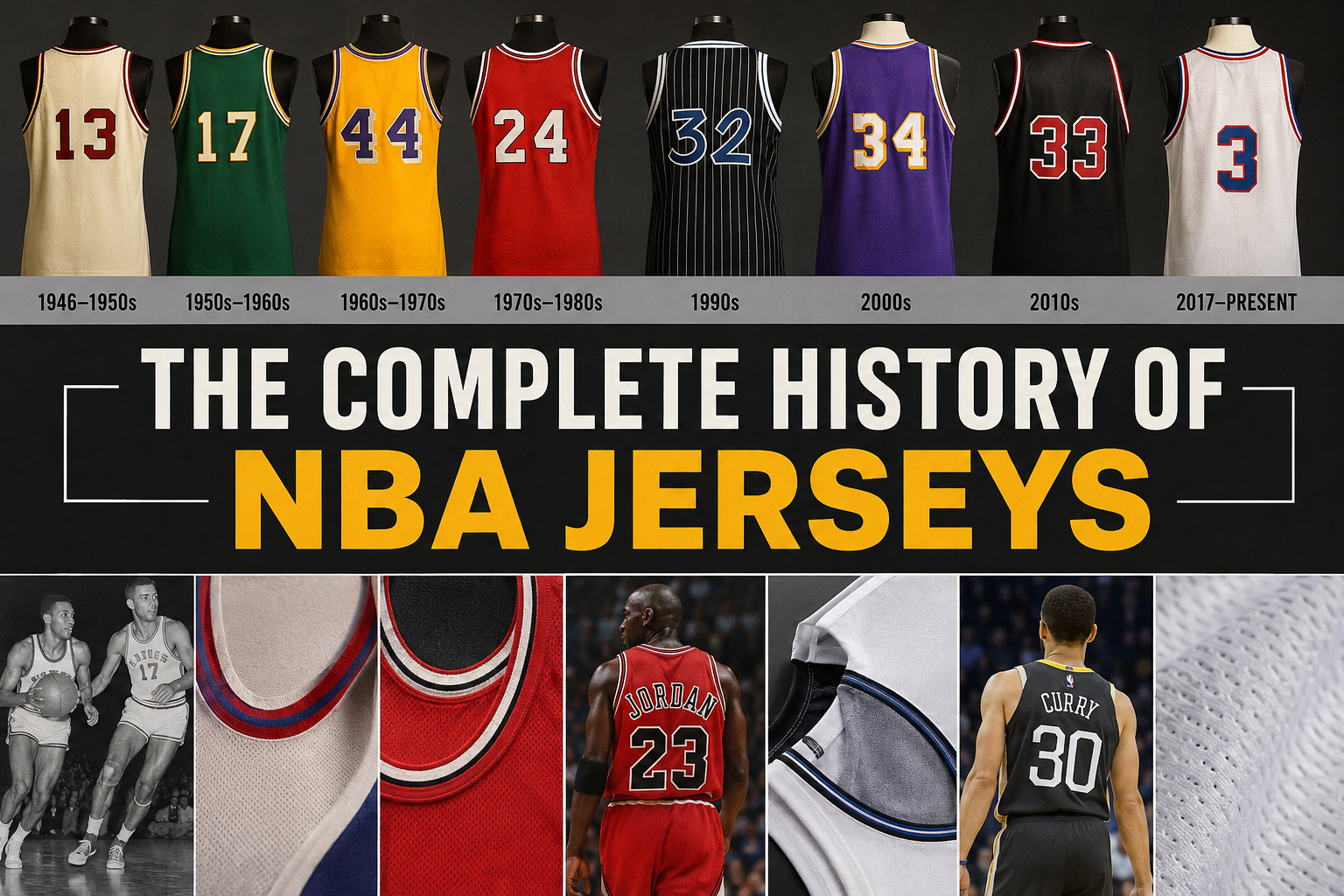
NBA jerseys have gone through five distinct manufacturing eras and several major design shifts since the league’s founding in 1946: an unregulated early period with no single supplier, a standardized Champion era through the 1990s, a fragmented multi-brand period from 1997–2004, an Adidas era of expanded alternate uniforms from 2006–2017, and the current Nike era, which introduced the five-category uniform system still in use today.
Origins: Early NBA Jerseys (1946–1980s)
In the league’s earliest decades, there was no single NBA-wide jersey supplier. Individual teams sourced uniforms from a mix of manufacturers — including Rawlings, Wilson, and various local suppliers — and consistency in cut, fabric, and design varied significantly from team to team.
Jerseys in this period were made of heavier materials like wool and cotton blends, worn as sleeveless tank tops with basic block numbering and minimal branding. There was no standardized alternate or “special edition” concept — teams wore a single home and away design for the full season.
The first step toward standardization came in 1986, when MacGregor Sand-Knit (evolving out of the earlier Medalist Sand-Knit) signed the NBA’s first exclusive league-wide uniform license, outfitting all teams through the late 1980s.
The Champion Era: Defining the Classic Look (1990–1997)
Champion took over as the NBA’s exclusive uniform supplier for the 1990–91 season and held that exclusive license through the 1996–97 season. This is the era most associated with the “classic” NBA jersey look: bold, saturated team colors, oversized front lettering, and mesh tank-top construction.
Champion jerseys from this period — worn by players like Michael Jordan, Magic Johnson, and Larry Bird — remain some of the most collected and referenced designs in NBA history, and are frequently the basis for modern “Classic Edition” throwback uniforms.
The Fragmented Era: Multiple Suppliers at Once (1997–2004)
Champion’s exclusivity ended after the 1996–97 season, opening the door to a period where several manufacturers outfitted different teams simultaneously:
- Champion continued producing jerseys for a subset of teams
- Nike and Starter entered the market outfitting other teams (Starter’s contracts were absorbed by Puma in 1999)
- Reebok signed a 10-year NBA licensing deal ahead of the 2001–02 season and began taking over additional teams
By the 2001–02 season, Champion, Nike, and Reebok were all simultaneously producing on-court NBA jerseys for different franchises — a level of manufacturer fragmentation that hasn’t been repeated since.
The Reebok and Adidas Era: League-Wide Consolidation Returns (2004–2017)
Reebok became the NBA’s exclusive uniform outfitter starting with the 2004–05 season, ending the fragmented multi-supplier period. In January 2006, Adidas acquired Reebok, and the NBA signed an 11-year, roughly $400 million exclusive deal with Adidas beginning with the 2006–07 season.
The Adidas era introduced several design concepts still used today, including expanded alternate and “swingman”-style jerseys and the earliest versions of what would later become City Edition uniforms — giving franchises more room to explore team history and local identity through uniform design rather than sticking to a single home/away look all season.
The Sleeved Jersey Experiment (2013–2017)
One of the most talked-about design changes in modern NBA history happened during this period. The Golden State Warriors wore the league’s first sleeved jersey on Christmas Day 2013, and several other teams followed with their own sleeved alternates over the next few seasons.
The experiment was controversial with players almost immediately — common complaints included restricted arm movement and a tighter, less breathable fit compared to the traditional tank-top cut. The NBA phased sleeved jerseys out entirely by the 2017–18 season, and the design has not returned since.
The Nike Era: Current Manufacturer and Uniform System (2017–Present)
Nike became the NBA’s exclusive on-court uniform and apparel provider starting with the 2017–18 season, ending Adidas’s 11-year run. The original agreement, signed in 2015, was an eight-year, roughly $1 billion deal.
In October 2024, Nike and the NBA announced a 12-year extension of that partnership, keeping Nike as the league’s exclusive uniform, apparel, and merchandising provider through 2037 — alongside the WNBA and NBA G League.
Nike’s takeover introduced two lasting changes to NBA jersey design:
- A visible manufacturer logo on the jersey front — a small Nike Swoosh on the chest, the first time a manufacturer’s branding appeared on official on-court jerseys.
- The five-category uniform system, which restructured how every team’s season wardrobe works:
| Uniform Category | Purpose |
|---|---|
| Association Edition | The primary white/light home uniform |
| Icon Edition | The primary colored road/alternate uniform |
| Statement Edition | A bold, often dark alternate designed as each team’s signature look |
| City Edition | A design tied to local culture, history, or identity, changed most seasons |
| Classic Edition | A throwback design referencing a past era of the franchise |
This system means every current NBA team wears at least five distinct jersey designs across a season, compared to the single home/away pairing common before the 1990s.
Jersey Materials: Then vs. Now
| Pre-1990s | 1990s–2000s | 2017–Present (Nike) | |
|---|---|---|---|
| Primary material | Wool/cotton blends | Mesh polyester | Moisture-wicking recycled polyester |
| Fit | Loose, boxy | Baggy, oversized armholes | Athletic, tailored cut |
| Numbering | Basic sewn-on block numbers | Screen-printed/twill | Lightweight thermo-bonded numbering |
Frequently Asked Questions
The Golden State Warriors wore the league’s first sleeved jersey on Christmas Day 2013. Several other teams introduced their own sleeved alternates over the following seasons, but the NBA phased the design out entirely by the 2017–18 season.
Nike has been the NBA’s exclusive uniform and apparel supplier since the 2017–18 season. In October 2024, Nike and the NBA extended that partnership for 12 more years, through 2037.
Adidas was the NBA’s exclusive uniform supplier from the 2006–07 season through 2016–17, after acquiring Reebok in 2006. Before that, Reebok held the exclusive license from 2004–06, and Champion held it through most of the 1990s.
Since 2017, every NBA team wears five uniform categories each season: Association (primary home), Icon (primary road), Statement (bold signature alternate), City (local-identity design, refreshed most seasons), and Classic (throwback design).
The looser, baggier NBA jersey fit — with larger armholes and longer shorts — became dominant through the 1990s and early 2000s, influenced heavily by hip-hop fashion trends of the era. Jersey fit has become progressively more athletic and tailored since Nike took over uniform production in 2017.
